HISTORY


The first Ukrainian settler in Yorkton, Paul Brosky, arrived in June, 1902. Many others soon followed, emigrating mostly from the villages of Hryhoriw and Chechiw in the area of Buchach, in Western Ukraine.
On January 13, 1904, Fr. Achilles Delaere, CSsR, along with other Belgian Redemptorists, arrived from Brandon, Man., to serve the people of Yorkton. The Fathers established St. Gerard’s Parish in the years 1904-05, and at the same time Fr. Delaere began working among the Ukrainian people, who until then had no spiritual guidance.
St. Mary’s Church was constructed in 1914; the monastery was finished by 1913. On August 23, 1914, the new church was blessed by Bishop Niceta Budka, and it soon became the spiritual center for Ukrainian Catholics from Wynyard to the Manitoba border.
The construction of the church was contracted by John Logan. The building was done of white bricks, which were manufactured from the sandy clay found near the very site of the church. It was the first Ukrainian Catholic Church in Western Canada to be built of brick.
Until the building of the church, Ukrainian Catholics used the chapel at St. Gerard’s for their services.
In 1920 Fr. N. M. Decamps, then the superior, added a west wing to the monastery, and also the whole third floor. These additions have at different times served as a Juvenate (minor seminary), a major seminary, and in the late ‘40s and early ‘50s as an elementary Parish School.
As the city grew, so did the parish. (In 1936 the population of Yorkton was 4,931). In 1941 the Annual Pilgrimage Day, on July 7, was attended by 4,000 people from Yorkton and district. The Pilgrimage is still an annual affair, but it is now observed on the weekend prior to the July long weekend.
The Icon of Our Mother of Perpetual Help, which originally hung behind the altar in church, was a certified copy of the original icon in Rome, and was hand-painted on wood. It was blessed by Pope Benedict XV in 1916. The Icon still remains displayed in the church sacristy.
The east wing of the church was built in 1955-56. In doing so, special regard had to be given to the pillars, which support the dome. The east wing had to be built narrow and long for this reason.
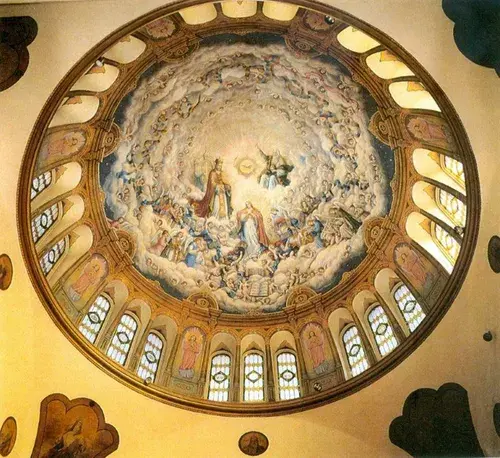
It was first necessary for the artist to visualize a central point on the diameter of the base of the curve and working from this point and a corresponding one on the floor, apply a series of geometric angles and logarithms to make his charcoal sketches. He spent two months making the projected drawings.
The main colors are the orange, indigo and dull red, as seen by Meush in Saskatchewan sunsets. Gallons of the best artists’ paints were applied, together with Meush’s own inks, which he was continuously seeking to improve. The paints penetrate to a depth of one-eighth of an inch to avoid injury should flakings of plaster fall away. The painting is further protected by many coats of varnish.
The painting is an original and represents the coronation of the Virgin Mary in heaven. The image stands out brightly and depicts God as “the Ancient of Days” (Daniel 7:9) blessing Mary. Jesus is depicted holding a crown over Mary’s head and the Holy Spirit is portrayed in the shape of a flying dove.
Surrounding the throne of God are 157 angels of different sizes. Below the feet of Mary, there is a sky-blue streamer with a yellow inscription bearing the words, “Hail, Virgin, Full of Grace, Queen of Heaven, Holy, Holy, Holy, Alleluia!”. Below the streamer there is an open book which reads: “Mary, Advocate, Protectress, and Perpetual Help of Christians.”
Around the dome are eight-sized angels. These were done with a spray gun and a pattern for each of the six colors. Other decorative work was done in a similar fashion.
Although the painting is the focal point of interest to the visitor, St. Mary’s Church contains other valuable paintings by outstanding artists. Rev Metzger painted the four Evangelists, one in each niche just beneath the dome.
The work of Stephen Meush can also be seen in the Ukrainian churches of St. Basil’s in Regina, SK, at Alvena, SK, Smuts, SK and Arran, SK, and in Transcona, Man.
YORKTON'S CATHEDRAL DOME
Few Yorkton citizens are aware that in their very own city exists one of the finest paintings of its kind in North America. The painting is in the dome of St. Mary’s Ukrainian Catholic Church.
Art critics have likened it, particularly in its soft matching colors, to the great religious paintings in Europe.
The painting covers the entire dome and has a curvature of over 62 feet. In 1941 an Ottawa art critic estimated the value of the painting at $35,000 or more.
It is the work of the late Stephen Meush, who died of a heart attack while on a fishing trip in Manitoba on June 21, 1951. Mr. Meush received his training in Lviv, Ukraine, and after three years of study in Italy he spent a year in Cracow, Poland, before coming to Canada 1932.
He was 36 years of age when he undertook the painting at St. Mary’s Church in September 1939. The task, which included a number of other paintings in the church, was completed in May 1941.
Similar to most artists, Mr. Meush worked only when inspired. There were days when he sat idly by with his thoughts, and then again he would work day and night without stopping to eat.
The top of the dome is 55 feet from the floor. The curvature required that the central figures, and the 157 angels and cherubs surrounding them, be painted in a distorted manner so that from floor level they would appear to be on a flat plane.
THE ICON OF OUR MOTHER OF PERPETUAL HELP

After the building of the east wing of the church in 1955-56, a large new icon of Our Mother of Perpetual Help was given the place of honor behind the altar; it was installed in 1964. The Icon was painted by Igor Suhacev of Toronto.
The Icon is a representation of the original Miraculous icon of Our Mother of Perpetual Help, which is venerated today at the Church of St. Alphonsus in Rome. This original is so ancient that it cannot be said with certainty who painted it. One legend attributes it to St. Luke.
This Byzantine Icon, contains much symbolism, which teaches by means of a story. Frightened by the vision of two angels showing Him the instruments of Passion, the Christ Child ran to His Mother, almost losing, in His haste, one of the tiny sandals. Mary holds Him in her arms reassuringly and lovingly. But notice her eyes. They look not at Jesus, but at us, thus signifying her motherly concern also for us.
Christ’s little hands are pressed into Mary’s as a reminder to us that, just as on earth, He placed Himself entirely in her hands for protection, so now in heaven He has given into Her hands all graces to distribute to those who ask her.
Among other symbols used is the star on Our Lady’s veil. She is the Star of the Sea, who brought the light of Christ to the darkened world, the star that leads us to the safe port of heaven. The entire background is golden, symbolic of heaven, and reflecting upon her clothing, shows the heavenly joy they can bring to tired human hearts.
The golden crown, placed on the original icon by order of the Holy See in 1867, is a token of the many miracles wrought by Our Lady invoked under the title of “Our Mother of Perpetual Help”.
Pope Pius IX entrusted this miraculous icon to the Redemptorists with the instruction: “See to it that Our Mother of Perpetual Help is made known throughout the world”.
It is most fitting that the Icon of Our Mother of Perpetual Help holds the place of honor in St. Mary’s Church in Yorkton, Sask., a church under the pastoral care of the Ukrainian Catholic Redemptorists.

The altar was installed in 1965. The altar and all the woodwork in the sanctuary was designed by the same artist that painted the Icon, Igor Suhacev. The woodcarving was done out of maple and birch by Warren Smith of Toronto.